


27 May POLITICS OF POTHOLES
Finally Someone Says It
When it comes to political discourse in 2026, there are few things off the table, sacrosanct … but an entire article dedicated to potholes may be one of them.
“But how can you write 1,458 words on potholes?” I hear you shout in anguish, “it’s just not possible.”
I’ll let you into a little secret … I’m not sure if I can, but I’ll leave that intro in, if I manage it!
So, where to start? I often begin my articles with a bit of history — let’s crack on.
The term pothole predates our modern road system, with its original historical meaning: ‘more or less cylindrical cavity from a few inches to several feet deep in rock’. The first recorded use appears to be back in 1826, referring to geological features in glaciers and gravel beds. Pot — from Middle English pot ‘a pit, a hollow, a deep hole for a mine or from peat-digging’. The term was first used to refer to a road surface in 1909.
So far, so pedestrian … so here’s some data to liven things up.
According to the government website1 in 2025, The United Kingdom has around a quarter of a million miles of roads — 247,200 to be precise. They break our road network down into major and minor roads; major includes motorways, A and B roads, while minor roads comprises the majority of the mileage with C and U roads.
U roads are urban, rural and local roads for the purposes of this data.
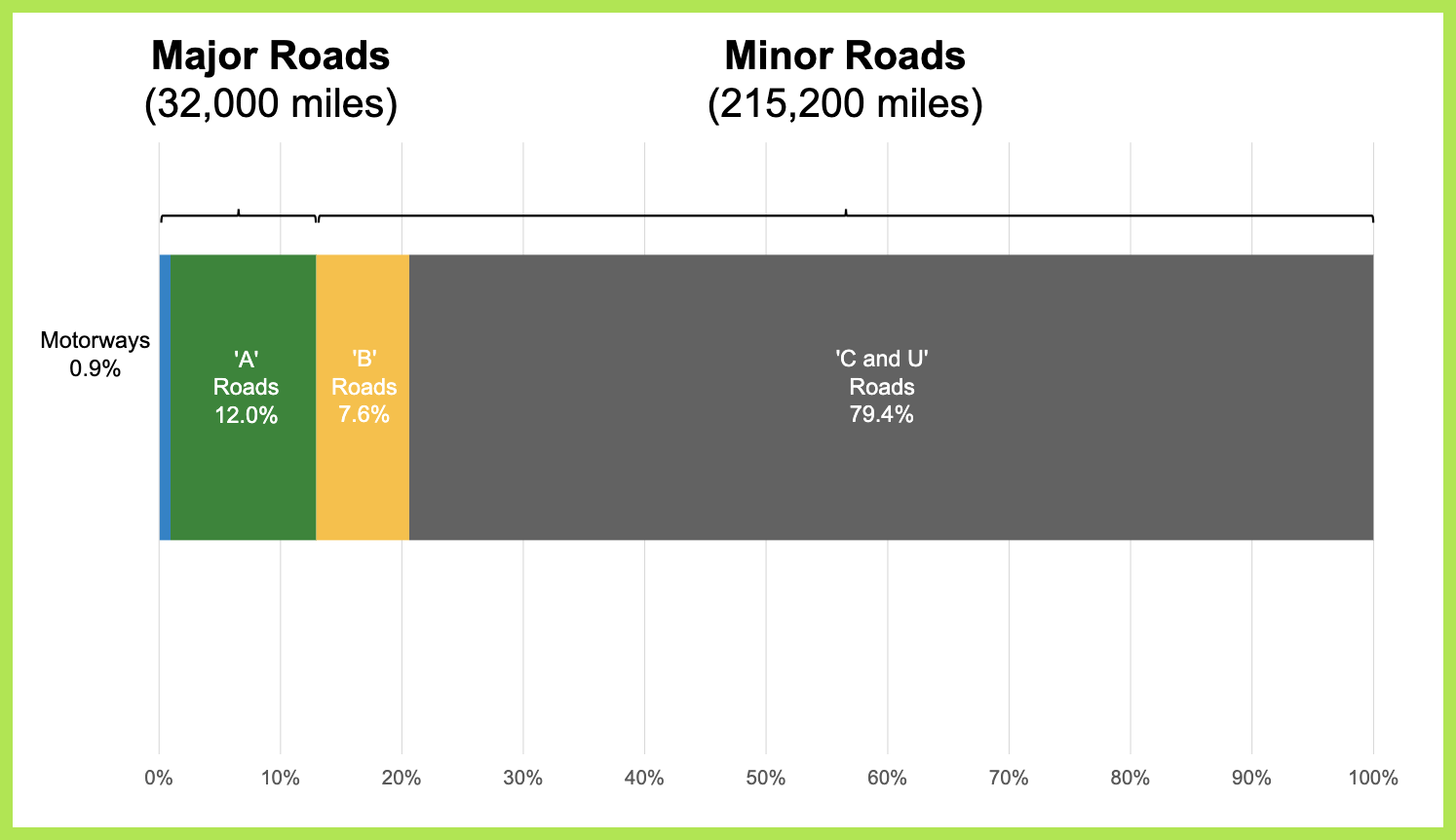
The vast majority of our pothole problems occur within that C and U bracket as you can imagine, but I do a reasonable amount of driving around the UK, and can confirm that our motorways are catching up, quickly.
That being said, in England, local roads comprise around 98% of the road network, and the National Audit Office says almost all journeys — by car, foot, bike or other transport — start and end on them. You can read the most recent, thrilling instalment of the Department for Transport’s — The condition and maintenance of local roads in England report here if you so wish. A real page turner … if you love hard facts about roads.
So it’s clear where the concerns lie across our road system and where the government, DfT and local councils need to focus their attention, but are they keeping up?
No. They are failing miserably in the upkeep of our roads, and the pothole situation feels out of control. In fact, it was a local councillor’s Facebook post that inspired me to write this piece. They took to social media to admit that it was impossible for our council to keep up and that they could never expect to repair the roads in the county. As a driver, that hit hard.
One final chunk of data before we move into the political response, or lack thereof.
In 2025, the RAC estimated that drivers face around one million potholes on our roads every year. One million. They recorded an increase of 15% from 2024 to 2025 in pothole related callouts, an average of 71 every day, involving damaged shock absorbers, broken suspension springs or distorted wheels. The AIA — Asphalt Industry Alliance, calculated in its 2026 survey report, ALARM2 [Annual Local Authority Road Maintenance], that the backlog of repairs across the country would cost £18.63 billion. They said that, if the full amount of money was provided to them by the government, it would still take twelve years to repair every road.
That puts my local councillor’s comments into stark context. Even if the government stumped up the near £19B required, it would take over a decade to get on top of things.
With the recent announcement that HS2 will cost over £100B and not be finished until well into the 2040s, and our road network in an impossible state of repair, it’s not hyperbole to state that our country’s infrastructure is fully broken.
Back to the government’s stats; they produce figures in detail for the condition of the roads classified as A, B or C, but when it comes to the U section — the vast majortiy of the network, they have little to no data because most of the roads are unsurveyed.
There is no official live count of potholes across the UK, but motoring organisations estimate drivers face at least one million of them every year, while councils in England and Wales filled 1.9 million potholes in 2025/26 alone. The RAC estimates an average of around six potholes per mile on council-controlled roads in England and Wales.
So what of the political response to this critical issue?
In March of 2025, the government took to the air waves to lay down the law to local councils, stating that: if they didn’t prove how many potholes were being repaired, they’d lose access to a share of £500,000 set aside for fixing roads in that year.
Five hundred million pounds, shared across 329 principal local authorities in England and Wales. That works out, if it was divided equally, £1,519.75 per council.
The conservative estimate from the AIA for the cash required to repair the roads again — £18.63 billion.
It’s not difficult to see why the roads are getting much, much worse if our councils are being offered 0.000008161922663802364% of the national budget to repair the roads.
Some quotes from those announcements:
Prime Minister, Keir Starmer said: “The broken roads we inherited are not only risking lives but also cost working families, drivers and businesses hundreds – if not thousands of pounds – in avoidable vehicle repairs.
“British people are bored of seeing their politicians aimlessly pointing at potholes with no real plan to fix them. That ends with us.
“We’ve done our part by handing councils the cash and certainty they need – now it’s up to them to get on with the job, put that money to use and prove they’re delivering for their communities.”
And Transport Secretary, Heidi Alexander said: “After years of neglect we’re tackling the pothole plague, building vital roads and ensuring every penny is delivering results for the taxpayer.”
This was over a year ago, and we have gone in reverse since these bold statements were lavished upon us by the Labour government.
I live in rural Gloucestershire and frequently drive around the country visiting family and friends — with the exception of Bristol city centre, our roads are the worst I have encountered. When I visited Clacton-on-Sea earlier in the year, I was seriously impressed by the lack of holes.
The problem in our country roads is getting worse and coupled with the increase in dangerous driving, it is leading to more frequent accidents. Drivers speed around the country lanes and weave in and out of the potholes, often crossing into the other side of the road to avoid them. We have had three local fatalities this year so far.
So it isn’t just a problem for our tyres and wheels, people are actually dying. The lack of road policing to curb the speeding and the catastrophic failure of the road surfaces is leading to the worst possible outcomes.
Political parties are using the pothole situation as a campaigning issue and Reform UK have been actively advertising JCB’s Pothole Pro, going to great lengths to promote a product from a prominent donor [under investigation by HMRC for an alleged £500M shortfall in his taxes].

But the sheer fact of the matter, despite hocking JCB merchandise, Reform UK led councils are as far behind as every other across the nation. They cannot keep up with the damage spreading throughout the road surfaces of the UK.
One final consideration — climate change.
The climate catastrophe that we are well and truly embedded within, is wreaking havoc with our tarmac. Extremes of cold, heat and rain exacerbate the pothole situation almost exponentially. The road surface expands in the heat, contracts in the cold, and is filled with more water than we can cope with. It’s no wonder that the shoddy repairs we see, only last a few weeks and, in fact, make the situation worse by widening existing holes when the repair tarmac is inevitably washed away.
With the increase in storms and weather events, things are rapidly deteriorating across the country, with very little hope of regaining the higher ground in the war against potholes.
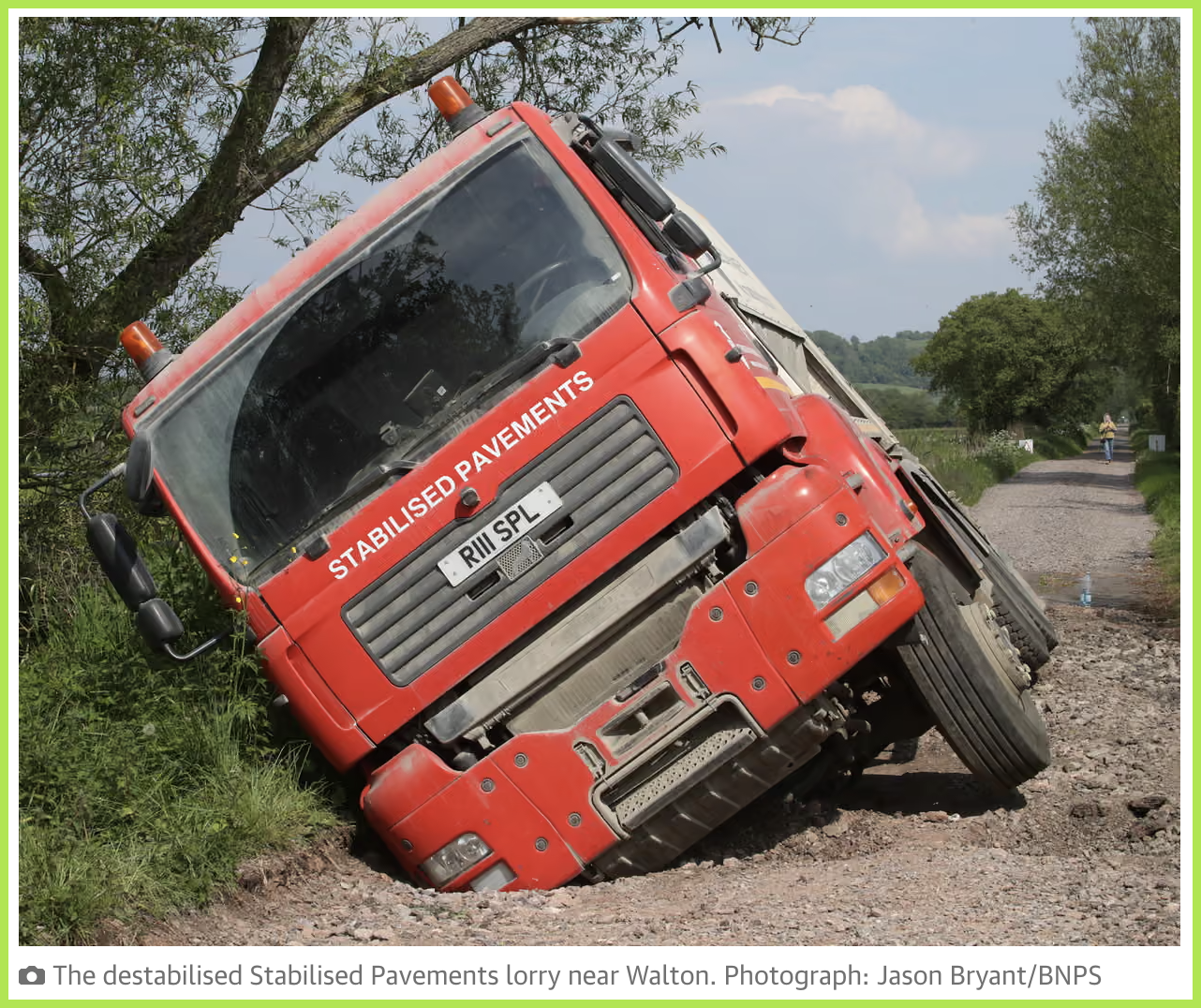
I’ll leave you with the recent news of a truck from a company called Stabilised Pavements, sent to repair some serious holes in Walton in Somerset. It was abandoned by its operators at a 45-degree angle after being beached … in a pothole.
I want to say a huge thank you to all of my supporters across all platforms. Your support is unbelievable and truly helps me to keep going with my work. I appreciate the pants off of every last one of you. 😍
If you have made it to this point, well done — this has been a long old slog. Thank you for reading, I sincerely appreciate it.
I don’t get paid for this stuff, so I have a couple of ways you can help out and support my work and research if you value my honesty and work. Firstly, you can subscribe to my Substack here.
Free or paid is spectacular and you’ll never miss an article. Or you can hit me up on Ko-fi for a donation or tip to help me with my research and keep me writing.

Please feel free to contact me with any questions or if you think you may have a story. I’m here on 𝕏 @donmcgowan or you can drop me an email, donmcgowan@pm.me or contact me in confidence on Signal. Thank you so much for reading.

Source: Gov UK Website
Source: AIA ALARM Survey Report 2026

No Comments